
The Project
Relapse rates for opioid addiction are as high as 90% with the majority of relapses (59%) occurring within one week. These startling statistics highlight the powerful addictions formed by opiates and emphasize the need to continue improving on existing rehabilitation therapies. A developing medical technology – neurofeedback - leverages neurological sensors (fMRI, EEG, etc.) to provide real time feedback about brain activity, enabling patients to increase desirable brain activity or reduce undesirable activity. We propose a pilot of neurofeedback therapy for opioid addiction treatment to help patients recover control of their minds and bodies to accelerate the path to recovery.
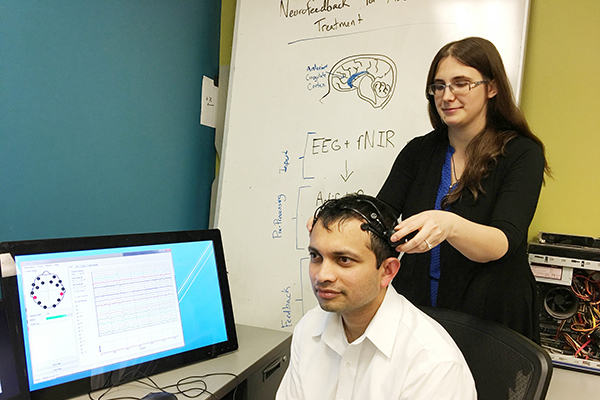
Neurofeedback captures real-time brain-activity and leverages visual or auditory feedback to give the user immediate insight into their brain function. This enables the user to reduce or enhance specific types of brain activity or areas of activity in order to alter unwanted neurological patterns. In the same way looking into a mirror enables you to stand straighter and make other subtle alterations to your bearing, using neurofeedback allows the brain to make subtle changes that would not be possible without that added insight.
Neurofeedback has been researched in many areas, including ADD/ADHD, tinnitus, chemotherapy-fog, and substance use disorder. Research has shown statistically significant reductions in cravings for participants using neurofeedback (in addition to traditional treatment) versus participants using only traditional treatment. We aim to build upon that research to identify effective neurofeedback protocols, measure their impact on opioid use disorder (OUD) treatment, and integrate the identified protocols into recovery programs.
The objective of this project is to enable UD researchers and students to perform a pilot study on the impact of neurofeedback in substance use recovery programs. The study would be performed by UD staff, faculty, and students. Subjects would be volunteers from local Dayton area recovery programs. The overall aim is to prove the effectiveness of neurofeedback in enhancing recovery and reducing relapse rates and to create a path to integrate it into current treatment programs. Our goal is to give individuals recovering from opioid use disorder the best possible chance of success.
If you are interested in learning more about neurofeedback check out the International Society for Neurofeedback & Research here: https://www.isnr.org/neurofeed...
Who We Are
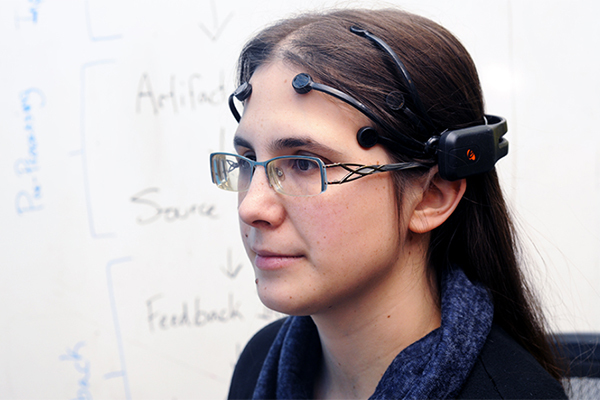
Our team pairs research engineers from the University of Dayton Research Institute's Sensor and Software Systems division with the capabilities of the UD Vision Lab. The team lead, Kelly (Cashion) Beigh (UDRI), has done prior research on brain machine interfacing and was one of the top five prize recipients for the Ohio Opioid Technology Challenge: Idea Phase. UDRI's Sensor and Software Systems Division brings sensor and signal processing expertise as well as human factors experience to the table. The UD Vision Lab has prior and ongoing projects using EEG including source localization, brain machine interfacing, and emotion recognition.
You can learn more about the Sensor and Software Systems team here:
- https://udayton.edu/udri/capab...
- https://udayton.edu/udri/capab....
More information on the UD Vision Lab including past and ongoing research projects can be found here:
- https://udayton.edu/engineerin...
The Impact
Your donation will make it possible for our team to gain the momentum necessary to identify and integrate effective neurofeedback protocols into the opioid use disorder treatment. Effective application of neurofeedback will reduce relapse rates and save lives.
What Your Gifts Will Do
Your generosity will fund the purchase of specialized neurofeedback equipment from Thought Technology Ltd. and a pilot study in partnership with Dayton area recovery programs.
- At 30% (~ $3000) we will be able to fund the initial purchase of a Neurofeedback Starter System (http://thoughttechnology.com/i...) will equip the team with the right tools to execute future case and pilot studies. The system comes with two EEG channels using high fidelity EEG electrodes to monitor brain activity. Additionally , the package comes with a suite of software with built in interfaces using audio and visual queues for neurofeedback.
- At 50% (~ $5000) we will be able to purchase the intermediate Neurofeedback Starter System (http://thoughttechnology.com/index.php/complete-systems/neurofeedback-intermediate-system.html). This system includes everything in the basic system but enables more simultaneous channels of biofeedback and includes a pIR system. The pIR system will enable us to combine EEG based neurofeedback with neurofeedback that tracks blood flow. This type of combination has been shown to improve results in prior studies.
- At 65% (~ $6500) we will be able to fund the design and implementation of a case study with two participants (experimental and control).
- At 80% (~ $8000) we will be able to expand the study to six participants.
- The fully funded project will cover a case study with ten participants.
Funding above and beyond our initial goal will further expand the study to involve more participants.
Share this Message
This opioid crisis affects our entire community - locally, across the state, across the country, and globally. Please share this project with others and let them know how they can get involved and make an impact.
Thank You for Your Support!
None of our work would be possible without your help! Thank you so much for your contribution!
No updates for this campaign.
Donors
View All Donors
